SORT Scanner.
Main Info.
What this is.
This page is an engineering record for SORT — part product history, part lab notebook, and part controlled public record. It documents the development path, design decisions, test milestones, and current state without publishing every detail required to reproduce the design.
SORT — Spectral Optical Recycling Type Scanner — is a handheld tool that reads the near-infrared fingerprint of a plastic part and identifies what it is in a few seconds. Built to take the guesswork out of sorting scrap before it enters the recycling stream, SORT targets the plastics that matter most to EcoSpool: PLA, PETG, ABS, and ASA.
Why I'm building it.
EcoSpool runs on trust — people drop off scrap, and it gets ground down and turned back into filament. That only works if what goes into a batch is actually what it's labeled as. Mixed or mislabeled scrap can ruin an entire batch, but visual inspection and the honor system aren't enough.
I wanted a fast, non-destructive way to verify each piece before it reaches the grinder — something closer to a lab-grade check, but cheap and fast enough to use on every piece. Cost-plus pricing, not profit-maximizing: the point of SORT is to make that level of verification accessible, not expensive.
How it works.
Rather than scanning a continuous spectrum like a lab spectrometer, the scanner fires four SWIR LEDs — 1200, 1450, 1550, and 1650 nm — one at a time, and reads how much of each bounces back off the sample with an InGaAs photodiode.
Each reading is normalized against a white reference, so the result is a reflectance ratio rather than a raw ADC value. The current firmware captures dark, reference, and sample measurements and calculates reflectance from those readings. The classifier interface is in place, but the trained classifier itself has not been deployed yet.
What's next?
- Short term: start testing on V2.
- Medium term: train and deploy the classifier on the dialed-in V2 hardware.
- Longer term: order the V3 boards, verify them, and move toward retail.
Every step, logged.
A running history of meaningful development steps. Dates are approximate where exact timestamps were not preserved. Board photos appear inline at the entries where each version was built.
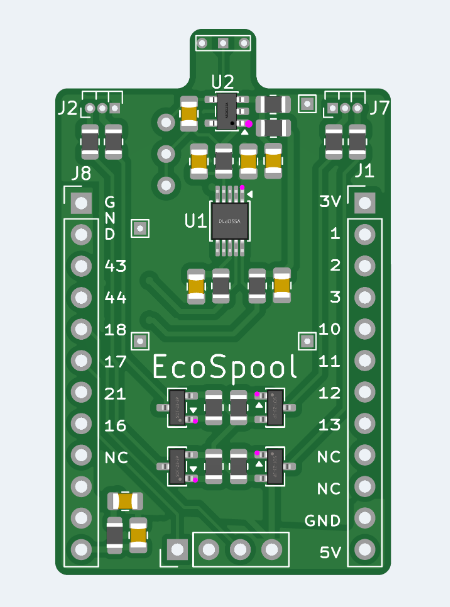
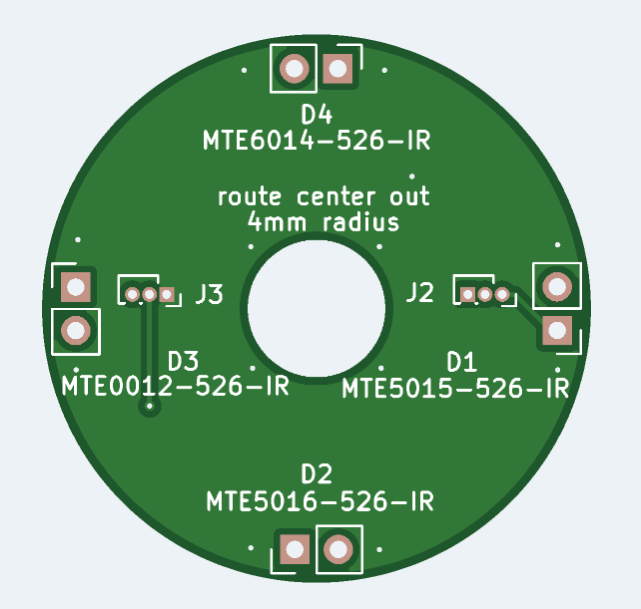
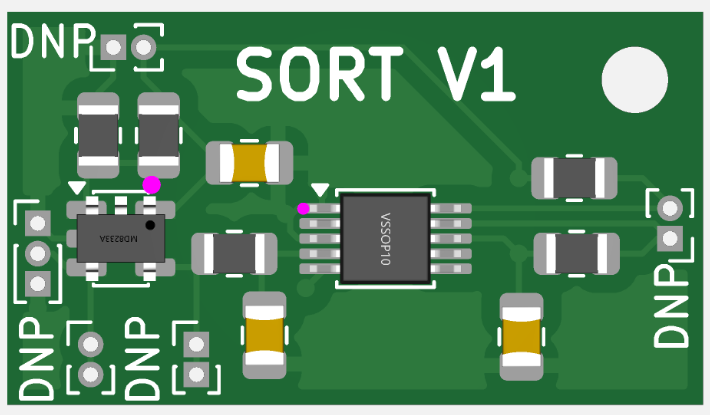
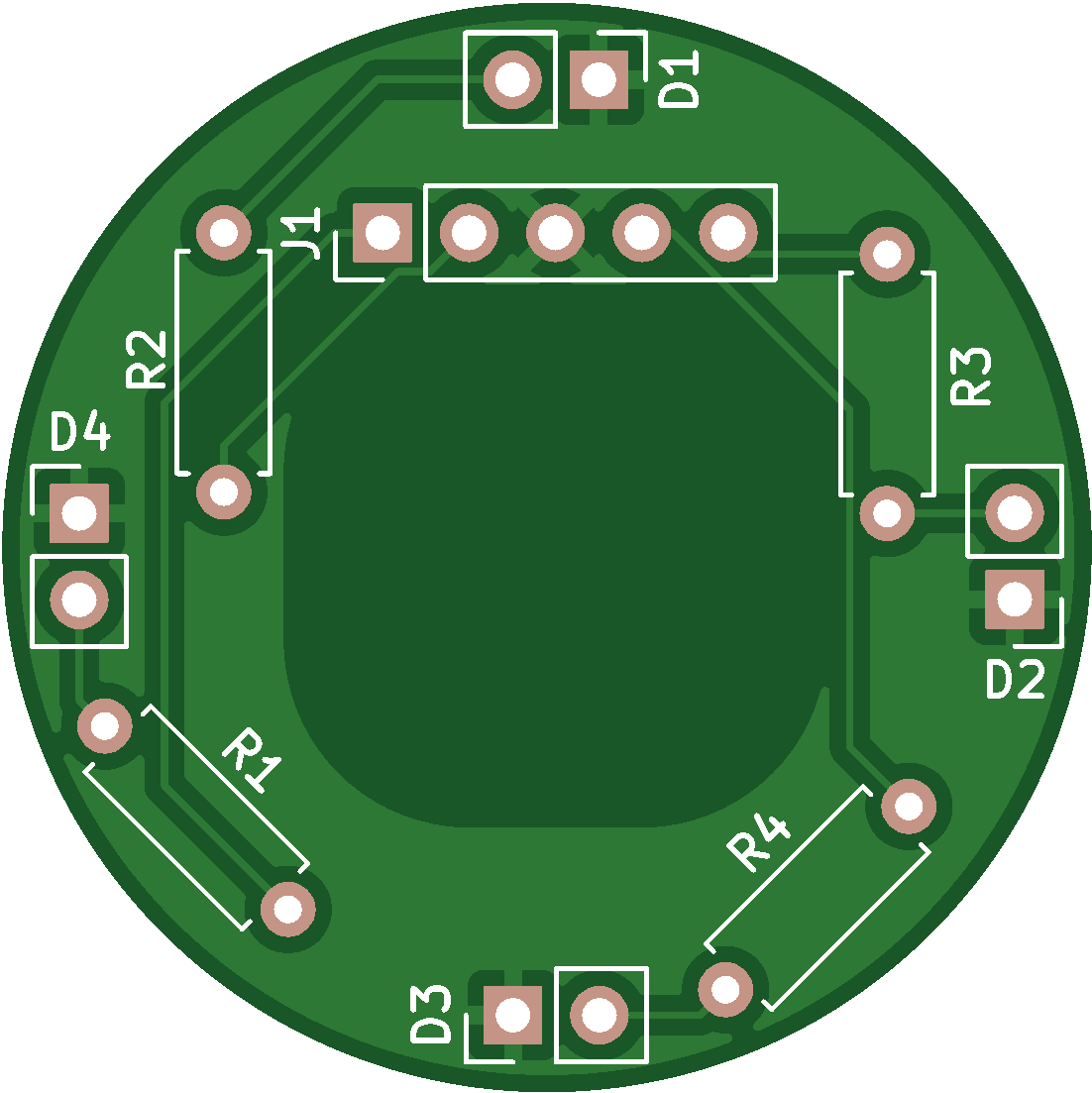
Latest build.
What's inside it.
Major components used in the current architecture.
A record, not a license.
This page establishes development history and communicates the project without functioning as a complete disclosure of the design.
SORT Scanner and its underlying designs are proprietary EcoSpool development. This page documents the project's history, major engineering decisions, and demonstrated results. Publication of this record does not grant permission to manufacture, reproduce, sell, distribute, or create derivative products from the design.
Technical details may be intentionally incomplete, summarized, or withheld. Public documentation should be understood as evidence of development and project history rather than a complete disclosure of the design.
Unless explicitly stated otherwise, names, branding, designs, documentation, firmware, hardware architecture, and related intellectual property remain under EcoSpool's control.